
4 min read

SOC vs. NOC: Which One Does Your Business Need?

SOC vs. NOC: Which One Does Your Business Need?

As businesses grow more reliant on digital infrastructure, the need to maintain both system performance and security becomes harder to manage internally.

The center of your operations is the heart of your business; now, the next step is determining what defenses or safety protocols are necessary to protect it.

That’s where understanding the difference between a Security Operations Center (SOC) and a Network Operations Center (NOC) becomes critical. While they serve distinct purposes, both play a key role in keeping your business operational, secure, and responsive. 


What Is a SOC vs. NOC?

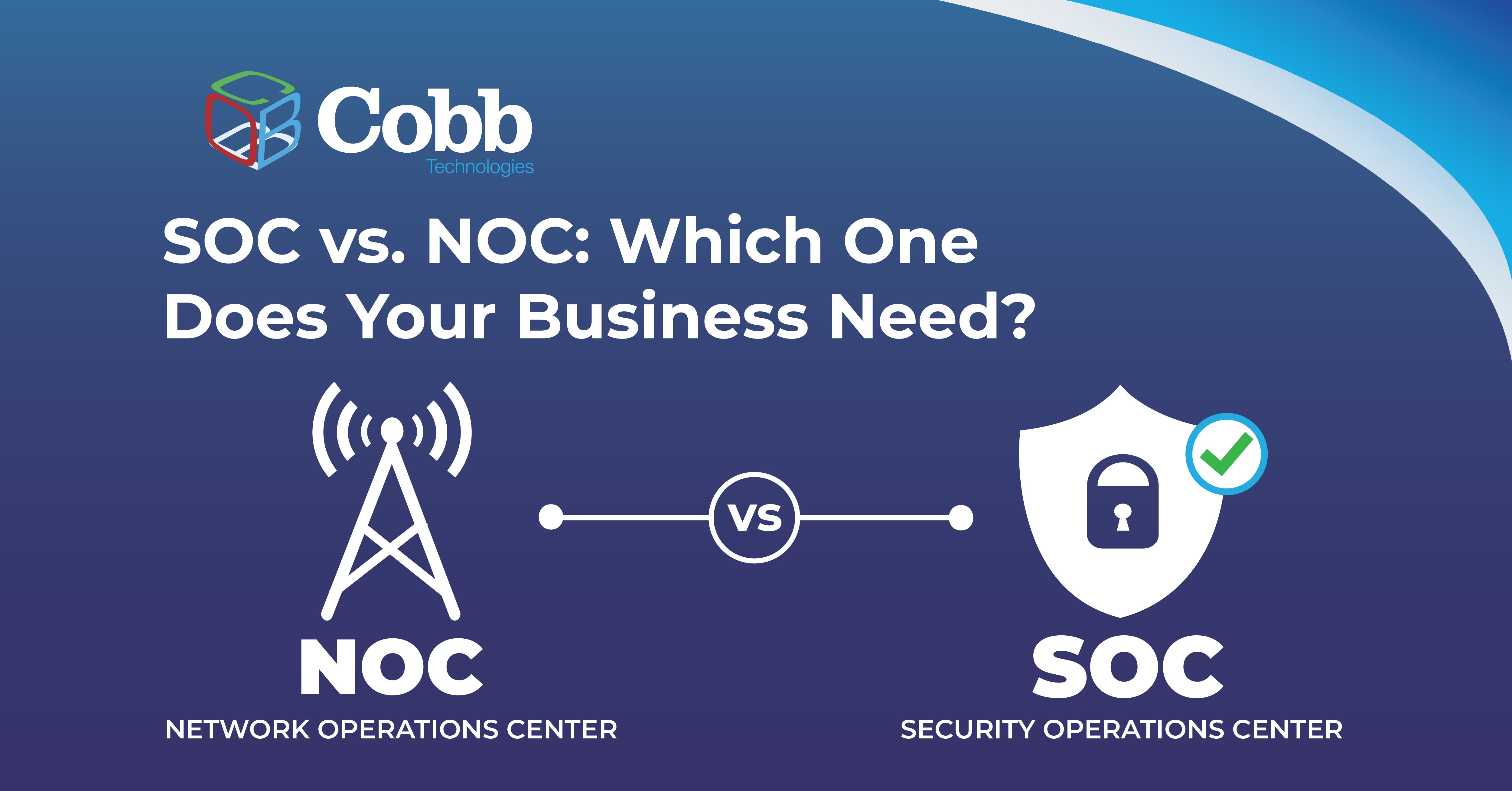
A Security Operations Center (SOC) and a Network Operations Center (NOC) are both centralized functions designed to monitor and manage IT environments, but they both produce different outcomes.

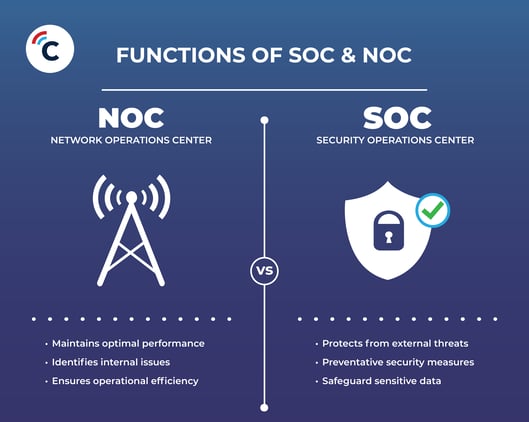
A SOC is responsible for protecting your business from external threats. It proactively monitors systems for signs of cyberattacks, including malware, phishing attempts, unauthorized access, and suspicious behavior. SOC teams analyze and respond to threats in real time, acting as a command center for cybersecurity. Their primary goal is to detect, investigate, and prevent security incidents before they escalate.

A NOC, on the other hand, is focused on the performance and reliability of your network. It monitors infrastructure such as servers, networks, devices, and connectivity to ensure everything is running efficiently. When issues arise, like outages, slow performance, or hardware failures, the NOC identifies and resolves them to minimize downtime. Its goal is to maintain uptime, optimize performance, and ensure business continuity.

At a high level, the difference comes down to this:

    • SOC = Protection from threats
    • NOC = Performance and uptime of systems

How They Work

The challenge most businesses face is not understanding what these functions are, but how they actually operate in a real environment and where their responsibilities begin to overlap.

Soc v Noc blog graphics-22

A SOC works by continuously analyzing data from across your systems, such as logs, user activity, access points, and endpoints, to identify unusual patterns. When something suspicious is detected, the SOC investigates, determines the level of risk, and takes action to contain or eliminate the threat. This process often runs 24/7, because cyber threats don’t follow business hours.

A NOC operates with a different lens. Instead of looking for threats, it’s looking for disruptions in performance. It monitors network traffic, system health, uptime metrics, and device connectivity. When performance drops or a failure occurs, the NOC responds by troubleshooting, rerouting traffic, or resolving infrastructure issues to keep operations running smoothly.

While both involve monitoring and rapid response, the key difference is intent:

    • SOC asks: "Is this a threat?"
    • NOC asks: "Is this working properly?" 
 

What Businesses Benefit from SOC vs. NOC?

Not every organization needs both functions immediately, but every business will feel the impact of not having the right one in place.

Businesses that handle sensitive data, operate in regulated industries, or rely heavily on secure client communication will benefit most from a SOC. This includes industries like legal, healthcare, and finance, where a single breach can lead to compliance issues, financial loss, and reputational damage. A SOC helps these organizations stay ahead of threats and maintain trust with their clients.

On the other hand, businesses that depend on consistent uptime. Whether for internal operations or customer-facing services, you will see immediate value from an NOC. If your team relies on stable networks, cloud systems, or remote connectivity, a NOC ensures those systems stay available and perform as expected.

For many small to mid-sized businesses, the reality is this:
Performance and security needs quickly form gaps in one area that impact the other.

Can You Use Both? (Layered Approach)

While SOC and NOC are often viewed separately, they are not mutually exclusive. In fact, as businesses grow, a layered approach becomes more practical and necessary.

A NOC might detect that a server is behaving abnormally, but without a SOC, it may not identify whether that issue is caused by a cyber threat. Similarly, a SOC might detect suspicious activity, but without NOC visibility, it may lack full context into system performance or infrastructure impact.

Combining both functions creates a more complete view of your environment:

    • NOC ensures systems stay up and running
    • SOC ensures those systems are secure while they run

For organizations scaling their operations, integrating both functions helps eliminate blind spots and creates a more proactive IT strategy.

How to Know What Your Business Needs

Choosing between a SOC, a NOC, or a combination of both starts with asking the right questions about your current environment and risks.

Ask Yourself If You Answer "Yes" Consider
Are you concerned about cyber threats, ransomware, or unauthorized access? Security is a top priority. SOC
Do you handle sensitive, confidential, or regulated data? Compliance and risk management matter. SOC
Are network outages, slow systems, or downtime impacting productivity? Reliability and uptime are critical. NOC
Do you struggle to identify and resolve infrastructure issues quickly? You need better visibility into your environment. NOC
Are security concerns and performance issues becoming increasingly interconnected? Both security and operations need attention.
SOC + NOC
Are you growing and need stronger visibility across your entire IT environment? Scalability and centralized management are important.
SOC + NOC


SOC and NOC serve different purposes, but both are essential to maintaining a stable and secure IT environment. As businesses grow and technology becomes more integrated into daily operations, relying on reactive support is no longer enough.

Understanding where your gaps exist, whether in performance, security, or both, is the first step toward building a more resilient infrastructure.

If you’re evaluating how to improve visibility, reduce downtime, or strengthen your security posture, CobbConnect can help you assess where your current environment stands and what approach makes the most sense for your business.

Start the conversation today and take a more proactive approach to managing your IT operations.


Resources


FAQ

What is the difference between a SOC and a NOC?

A SOC monitors, detects, and responds to cybersecurity threats 24/7. It helps prevent ransomware, malware, phishing attacks, and unauthorized access before they disrupt your business.

Do I need a SOC or a NOC?

You need a SOC if cybersecurity is your biggest concern, and a NOC if system uptime and performance are your priority. Many growing businesses benefit from both because security and network performance often go hand in hand.

What does a Security Operations Center (SOC) do?

A SOC monitors, detects, and responds to cybersecurity threats 24/7. It helps prevent ransomware, malware, phishing attacks, and unauthorized access before they disrupt your business.

What does a Network Operations Center (NOC) do?

A NOC monitors and maintains your IT infrastructure to maximize uptime and performance. It identifies network issues, outages, and hardware failures before they impact users.

Can a business use both a SOC and a NOC?

Yes, many businesses use both a SOC and a NOC for complete IT protection. A NOC keeps systems operational, while a SOC keeps those systems secure from cyber threats.

Who should invest in a SOC?

Businesses that store sensitive data or operate in regulated industries benefit most from a SOC. Legal firms, healthcare organizations, financial institutions, and growing businesses often require continuous cybersecurity monitoring.

How do I know if my business needs additional IT monitoring?

If you're experiencing downtime, performance issues, or growing cybersecurity concerns, it's time to evaluate your IT monitoring strategy. A professional assessment can determine whether a SOC, a NOC, or both are the right fit.

SOC vs. NOC: Which One Does Your Business Need?

8 min read

SOC vs. NOC: Which One Does Your Business Need?

As businesses grow more reliant on digital infrastructure, the need to maintain both system performance and security becomes harder to manage...

Reactive IT vs. Proactive IT Management

11 min read

Reactive IT vs. Proactive IT Management

For many small and mid-sized businesses, technology problems don’t show up as major failures right away. Instead, they appear as slow networks,...

6 min read

"The Mother of Wi-Fi" Hedy Lamarr

In honor of Women’s History Month, we’re recognizing the groundbreaking contributions of Hedy Lamarr, a Hollywood star and tech innovator whose work...