5 min read
What Healthcare Organizations Should Look For When Picking an IT Partner
Healthcare organizations don't just need IT support; they need a partner who understands compliance, security, and what's actually at stake when...
3 min read
Joshua Thornton Aug 25, 2026, 7:59:59 AM
Healthcare organizations don't just need IT support; they need a partner who understands compliance, security, and what's actually at stake when patient data is on the line.In 2025, healthcare data breaches reached an average cost of $10.22M per incident, more than double the cross-industry average. These breaches take an average of 279 days to detect and contain. The risk isn't just financial; it's patient trust, regulatory standing, and continuity of care.
Here are 4 things that separate a reactive IT vendor from a real strategic partner.
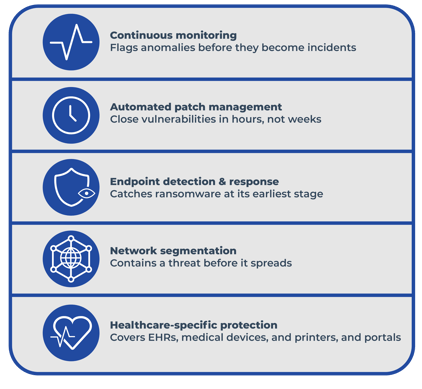
A top MSP doesn't wait for an alert to sound. A proactive security approach should transform healthcare IT from a reactive scramble into a strategic advantage. Your MSP should offer:

HIPAA isn't a checklist; it's an ongoing operational requirement, and the penalties for getting it wrong keep climbing (HHS has collected over $28 million in HIPAA settlements in recent years). The right MSP treats compliance as infrastructure: encryption by default, role-based access controls with full audit logs, and disaster recovery built to meet HIPAA's contingency requirements. If you're also navigating state privacy laws or frameworks, your MSP should already know how those requirements overlap.
Healthcare organizations don't stand still. You're adding providers, expanding to new locations, integrating acquired practices, implementing new care delivery models, and adopting technologies that didn't exist five years ago. Your IT infrastructure needs to support that growth without creating bottlenecks, security gaps, or budget crises.
The best MSPs approach technology as a strategic enabler; they'll sit down with your leadership team to understand your three-year growth plan, your clinical priorities, and your patient experience goals. Then they'll build an IT roadmap that anticipates your needs rather than reacting to them. That means network capacity planning that accommodates telehealth expansion. It means cloud migration strategies that support multi-site operations without compromising performance. Beyond security and compliance, the best MSPs act like an extension of your leadership team:
Advanced Technology With Human-Centered Support
At Cobb, we've seen how the right combination of advanced technology and accessible support transforms healthcare operations. That means implementing automated monitoring systems that catch issues before users notice them, but backing those systems with technicians who can troubleshoot complex problems in real time. It means deploying multi-factor authentication and zero-trust security architectures, but providing user training that makes adoption smooth rather than disruptive. It means offering 24/7 support that responds to emergencies immediately, with technicians who understand that downtime in healthcare can impact patient safety. That combination of advanced technology and human-centered support is what separates reactive IT vendors from true strategic partners.
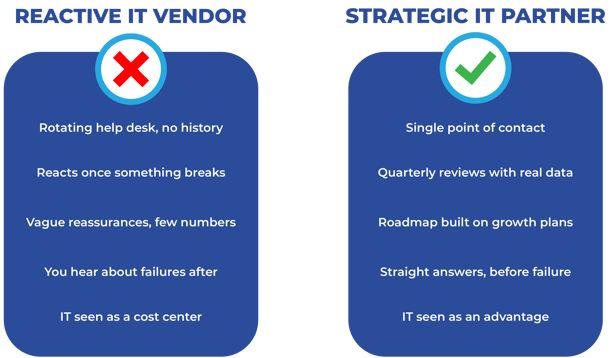
Technology should make your team's job easier, not harder. When it does, IT stops being a cost center and starts being a competitive advantage.
Not sure where your organization stands?
With CobbConnect's free network assessment, we'll show you exactly where your security, compliance, and infrastructure stand today.
Citations:
IBM. Cost of a Data Breach Report 2025. IBM, 2025, www.ibm.com/reports/data-breach
United States, Department of Health and Human Services, Office for Civil Rights. "Enforcement Highlights." www.hhs.gov/hipaa/for-professionals/compliance-enforcement/data/enforcement-highlights/index.html
IBM's 2025 Cost of a Data Breach Report puts the healthcare industry average at $7.42 million per incident — the highest of any industry for 14 consecutive years. Healthcare breaches also take longer to catch than in other sectors, averaging 279 days to detect and contain.
Healthcare organizations run on systems — EHRs, medical devices, imaging platforms, patient portals — that carry both cybersecurity risk and direct patient-safety risk if they go down. IT support also has to operate inside HIPAA's compliance requirements, not just general best practices, which changes what "good IT" looks like day to day.
A vendor responds to tickets and outages as they happen. A partner builds a roadmap around your organization's growth, gives you regular visibility into uptime and cost data, and flags aging systems before they fail rather than after. The distinction shows up most clearly during growth — adding providers, opening locations, or integrating an acquired practice.
An MSP can build the technical infrastructure HIPAA requires — encryption by default, role-based access controls, audit logging, and disaster recovery aligned to HIPAA's contingency planning rules — but compliance is an ongoing operational responsibility, not a one-time setup. The right MSP treats it as continuous infrastructure rather than a checklist to complete once.
The clearest signs are a reactive support pattern (you hear about problems after they cause downtime), no regular reporting on uptime or costs, and no forward-looking technology roadmap tied to your growth plans. A network assessment is the fastest way to get a concrete answer rather than guessing — see the CTA at the end of this post.
5 min read
Healthcare organizations don't just need IT support; they need a partner who understands compliance, security, and what's actually at stake when...
9 min read
Watch Our Patching and Updating Video Below
8 min read
As businesses grow more reliant on digital infrastructure, the need to maintain both system performance and security becomes harder to manage...